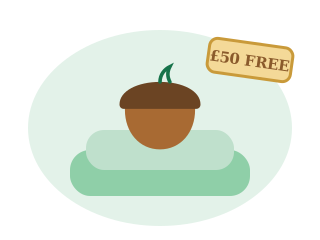
Demo rate card29.9% EAR (variable), with the first £50.00 interest-free
The pound values and percentages on this page are invented AcornBank product terms, chosen for a realistic bank-style example. They are not current market offers, an invitation to deposit or invest money or a forecast of what a real bank will pay.
| Product detail | Demo terms |
|---|---|
| Account type | Arranged overdraft |
| Rate, reward or charge | 29.9% EAR (variable), with the first £50.00 interest-free |
| Illustrative credit limit | £0.00 to £1,000.00 |
| Access | Up to £1,000 arranged borrowing; the first £50 is interest-free in this demo model |
| Eligibility in the scenario | An adult Acorn Everyday story customer with an assumed arranged limit |
| Fees | No model account fee |
| Currency | GBP (£), used solely for fictional calculations |
Try your own numbers
Change the amounts to see what Overdreyft Buffer would do in the story. Fictional figures, no application, no advice.
- Interest-free portion
- £50.00
- If it lasted a full year
- £134.55An overdraft is a cushion, not a loan.
Overdreyft Buffer against the rest of current accounts
| Feature | Acorn EverydayNO MONTHLY FEE · NO INTEREST | Branch Out Business£6 MONTHLY FEE · NO INTEREST | Overdreyft Buffer29.9% EAR · FIRST £50 FREE |
|---|---|---|---|
| Type | Current account | Business current account | Arranged overdraft |
| Rate, reward or charge | 0.00% credit interest; £0.00 monthly account fee | 0.00% credit interest; £6.00 monthly account fee | 29.9% EAR (variable), with the first £50.00 interest-free |
| Minimum | £0.00 | £0.00 | £0.00 |
Overdreyft Buffer in charts
The same fictional model as the tables below, drawn rather than written. Hover or focus a mark for its value, or open the table view.
- 7 days
- 30 days
- 90 days
Constant borrowed balance; the EAR is converted to a daily equivalent.
View as a table
| Category | 7 days | 30 days | 90 days |
|---|---|---|---|
| £50 | £0.00 | £0.00 | £0.00 |
| £100 | £0.25 | £1.09 | £3.33 |
| £250 | £1.01 | £4.35 | £13.33 |
| £500 | £2.26 | £9.78 | £29.98 |
| £1,000 | £4.78 | £20.65 | £63.30 |
How much could a shortfall cost?
| Borrowed balance | After 7 days | After 30 days | After 90 days |
|---|---|---|---|
| £50.00 | £0.00 | £0.00 | £0.00 |
| £100.00 | £0.25 | £1.09 | £3.33 |
| £250.00 | £1.01 | £4.35 | £13.33 |
| £500.00 | £2.26 | £9.78 | £29.98 |
| £1,000.00 | £4.78 | £20.65 | £63.30 |
Assumptions: constant borrowed principal, no deposits, additional borrowing or fees; the first £50.00 remains interest-free. Estimated cost = max(balance − buffer, 0) × [(1 + 0.299)^(days/365) − 1]. This converts the illustrative EAR into an equivalent daily-compounding model and rounds only the final charge. It is an estimate, not a contractual daily posting schedule. An overdraft costs money; it does not produce a return.
Overdreyft Buffer is arranged overdraft in the Current accounts range, used for illustrating the cost of a short-lived current-account shortfall. Its live rate card, summary and worked tables sit above this text and update whenever the product record changes.
Understand the headline rate
Savings AER expresses annual interest including compounding where relevant; gross means before tax and tax-free means the demo ISA wrapper deducts none. APR and EAR describe borrowing costs on different stated bases. Cashback and 0% offers are perks on qualifying activity, not interest on a balance. Compare matching measures and read the assumptions below before comparing the numbers.
See the whole Current accounts range or compare every product on the rates page.
What the example does not promise
All figures are invented and shown to make the demo useful to read and crawl. No money is held, no application is available, and no deposit-protection, regulatory or tax-wrapper status is claimed. Calculations do not account for personal tax, inflation or unstated changes in rates. The fictional bank manager can guarantee only that the next paragraph contains no real acorns.
Related reading
- This Is a Fictional Bank — No Real Banking Here
- Site Map — Every Branch of AcornBank
- Rates — Savings, Borrowing and Rewards
- Help — Unruffle Your Tail
- Current Accounts — Everyday Banking for Busy Squirrels
- Overdreyft Buffer — Nutworthy Features
- Overdreyft Buffer — Which Squirrels Can Join?
AcornBank: entirely fictional banking, exceptionally committed squirrels.